


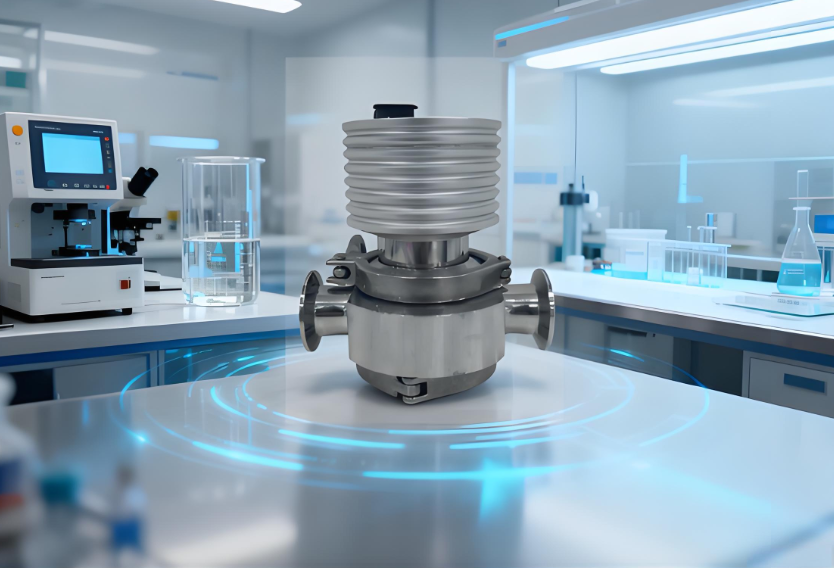
In various industrial fields such as chemical engineering, pharmaceuticals, and water treatment, hydrazine hydrate serves as an important chemical raw material with a wide range of applications. However, the precise control of hydrazine hydrate concentration is directly related to process stability, product quality, and production safety. Therefore, establishing an efficient and reliable concentration detection system is crucial. With its advantages of real-time monitoring and easy operation, the Inline Refractometer has become an ideal device for hydrazine hydrate concentration detection, among which the CHNSpec Inline Refractometer CRN series performs particularly well in actual applications.
I. What is Hydrazine Hydrate?
Hydrazine hydrate, with the chemical formula N₂H₄·H₂O, is a colorless transparent liquid with strong reducibility. It easily absorbs moisture and carbon dioxide from the air and has certain alkalinity. Due to its unique chemical properties, hydrazine hydrate plays multiple roles in industrial production: in the pharmaceutical field, it can be used as an intermediate for synthesizing certain drugs; in the chemical industry, it is an important raw material for producing blowing agents and antioxidants; in water treatment, it can be used as a boiler water deoxidizer to effectively prevent equipment corrosion.
It is worth noting that concentration is the core indicator governing the performance of hydrazine hydrate. Excessively high concentration may lead to overly intense reactions and increase production risks; excessively low concentration may reduce product yield or affect treatment effectiveness. Therefore, accurately mastering hydrazine hydrate concentration is an indispensable step in industrial production.
II. Why Monitor Hydrazine Hydrate Concentration?
Continuous monitoring of hydrazine hydrate concentration in industrial production is essentially to ensure process stability, safety, and economic efficiency throughout the entire production cycle. This can be analyzed from three core dimensions.
1. Ensuring product quality stability.
In production processes that use hydrazine hydrate as a raw material, its concentration directly determines the reaction process and product quality. For example, in the synthesis of pharmaceutical intermediates, slight fluctuations in hydrazine hydrate concentration may reduce product purity and affect subsequent pharmaceutical production; in blowing agent manufacturing, concentration deviations may cause foam performance differences and reduce product yield. Through accurate monitoring and control of concentration, process parameters can remain stable, thereby ensuring product quality consistency.
2. Strengthening production safety control.
Hydrazine hydrate has certain hazards, and excessively high concentration may increase safety risks under specific conditions. At the same time, abnormal concentration may indicate system leakage, uneven mixing, or other process issues. Real-time monitoring can promptly identify abnormalities, provide warnings to operators, and facilitate timely corrective action—reducing the likelihood of accidents and ensuring a safe production environment.
3. Achieving production cost optimization.
As an industrial raw material, the usage of hydrazine hydrate is closely tied to its concentration. Inaccurate monitoring may lead to excessive dosing and waste, or insufficient concentration requiring reworking and increasing production costs. By mastering concentration data in real time, the amount of hydrazine hydrate added can be precisely controlled, avoiding raw material waste and reducing losses caused by concentration deviations, enabling rational cost management.
III. What Are the Principles and Advantages of Using Inline Refractometers for Hydrazine Hydrate Detection?
The core principle behind using Inline Refractometers for hydrazine hydrate concentration detection is the inherent relationship between refractive index and concentration. The refractive index is an important physical property, and when the concentration of hydrazine hydrate solution changes, its molecular density changes accordingly, leading to systematic changes in the refractive index. The Inline Refractometer precisely measures the refractive index of the solution and calculates the real-time concentration based on a preset concentration–refractive-index correlation.
Compared with traditional offline detection, Inline Refractometers show significant advantages in hydrazine hydrate concentration detection. Traditional offline methods require manual sampling and laboratory analysis, which are time-consuming, cannot reflect real-time changes, and may introduce errors caused by volatilization or contamination. Inline Refractometers, however, can be installed directly on production pipelines, achieving continuous real-time monitoring with rapid updates, immediately reflecting concentration fluctuations to support fast process regulation. Moreover, online detection reduces manual operations, lowering labor costs and eliminating human-induced errors, greatly enhancing data reliability.
IV. What Advantages Does the CHNSpec Inline Refractometer CRN Series Offer in Hydrazine Hydrate Monitoring?
In online detection of hydrazine hydrate concentration, the CHNSpec Inline Refractometer CRN series stands out due to its adaptability and stability. Using advanced optical detection technology, it precisely captures subtle changes in the refractive index of hydrazine hydrate solution, enabling accurate measurement that meets industrial concentration detection requirements.
Considering the complexity of industrial environments, the CHNSpec CRN series is designed with strong environmental adaptability. Its structure can withstand temperature fluctuations, vibrations, and other disturbances during production, ensuring stable operation and consistent detection accuracy even in harsh environments. Additionally, installation and maintenance are simple, allowing flexible deployment based on pipeline layout while keeping operating costs low.
Furthermore, the CHNSpec CRN series features comprehensive data transmission and display functions. Concentration data can be transmitted in real time to control systems or display terminals, allowing operators to visually monitor concentration changes and promptly adjust process parameters. This efficient data processing and feedback capability further enhances process controllability and supports refined production management.
Precise control of hydrazine hydrate concentration is key to ensuring production quality, safety, and efficiency in related industries. With its real-time, accurate, and efficient detection capabilities, the Inline Refractometer provides a reliable solution for hydrazine hydrate concentration monitoring. The CHNSpec CRN series, with its exceptional performance, plays an important role—enhancing process controllability, reducing production costs, safeguarding production safety, and becoming an essential detection device in industrial production.