


In today's global manufacturing industry, where ultimate quality is pursued, color consistency is a direct reflection of brand power. Whether it is automotive paint, plastic products, textiles, or food packaging, a slight color deviation can lead to product returns or damage to brand image. So, what exactly is a colorimeter—the "sharp eye" used to accurately capture and quantify color in industrial production? And how does it work? This article will take you through a comprehensive understanding of this core color measurement tool.
1. What Is a Colorimeter?
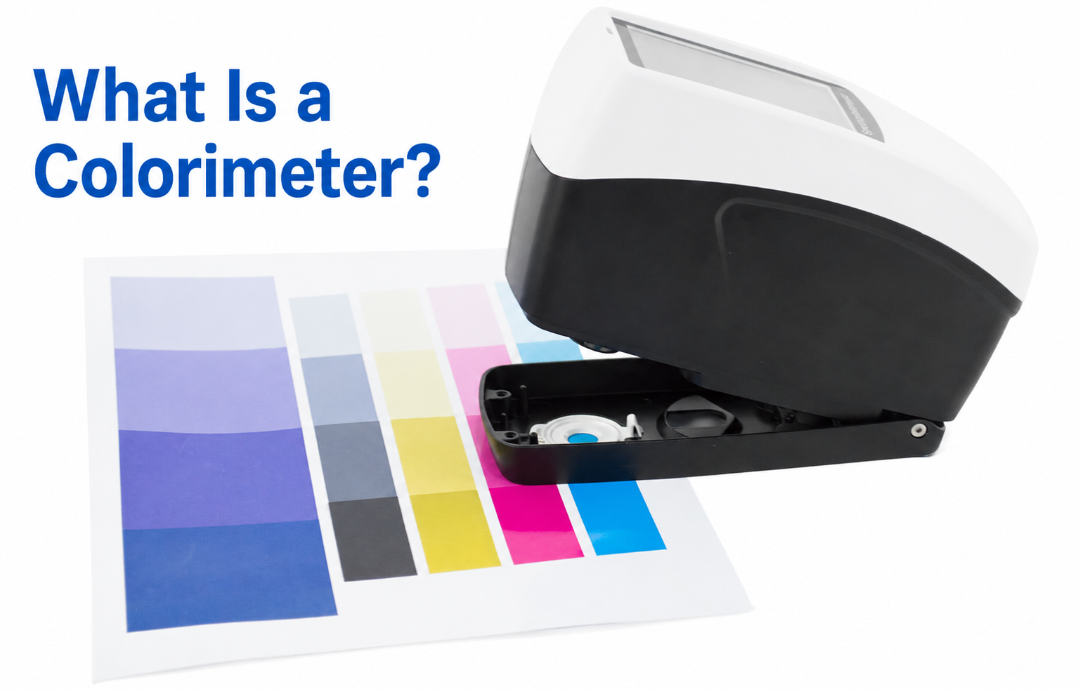
A colorimeter is a highly precise psychophysical color measurement instrument used to quantify and describe the color of a sample. It mimics the human eye's perception of color but eliminates human subjectivity, fatigue, and environmental lighting variables.
By measuring the absorbance and transmittance of specific wavelengths of light, a colorimeter converts visual color into objective, standardized numerical data (such as L*a*b* or L*C*h* color spaces). This allows manufacturers to establish a clear "color standard" and measure the precise deviation (known as ΔE) between a production sample and the target color.
2. How Does a Colorimeter Work?
To understand how a colorimeter works, we can look at its internal optical system, which generally consists of three core components: a light source, a set of filters, and a photosensitive detector. The process follows these precise steps:
Step 1: Illumination: The instrument’s internal standard light source (usually a long-life LED or Xenon lamp) shines a broad-spectrum light onto the surface of the sample.
Step 2: Filtering: The light reflected from or transmitted through the sample passes through a set of specialized tristimulus filters. These filters mimic the sensitivity of the human eye's three types of color receptors (red, green, and blue cones).
Step 3: Detection & Calculation: The filtered light hits a high-sensitivity photodetector, which measures the intensity of each primary color wavelength. The internal microprocessor then calculates these signals into international standard tristimulus values (X, Y, Z) and outputs them as readable coordinates like L*a*b*.

Through the above formula, the colorimeter instantly tells you if the sample is too red, too blue, too dark, or too light compared to your standard.
3. What Are Colorimeters Used For?
Colorimeters are essential quality control (QC) tools utilized across a vast range of industries where color accuracy is critical. Their primary applications include:
Quality Control & Inspection: In manufacturing lines (plastics, textiles, paints, coatings), colorimeters are used to check incoming raw materials and inspect finished products to ensure they match the approved master sample.
Pass/Fail Assessment: Suppliers use colorimeters to set specific tolerance limits (ΔE < 0.5). If a production batch exceeds this limit, the instrument flags it as a "Fail," preventing defective goods from being shipped.
Supply Chain Standardization: For global brands, colorimeters ensure that components manufactured by different suppliers in different countries (e.g., the plastic cap and the glass bottle of a cosmetic product) match perfectly when assembled.
Aging and Durability Testing: Companies use them to monitor color degradation or fading over time when products are exposed to UV light, weather, or chemicals.

4. Colorimeter vs. Spectrophotometer
While both instruments are used to measure color, they differ significantly in complexity, technology, and price. Understanding the differences is crucial for choosing the right tool for your business:
A colorimeter is more like a rapid color diagnostic tool. It is compact, fast, and cost-effective, making it ideal for routine color quality inspections and spot checks on factory production lines.
A spectrophotometer, on the other hand, is a comprehensive color analysis instrument. It not only provides color difference values but also analyzes the spectral reflectance curve of an object under different light sources. This makes it the ultimate solution for laboratory research and development, computer color matching (CCM), and challenging materials such as highly reflective or textured surfaces.
|
Feature |
Colorimeter |
Spectrophotometer |
|
Technology |
Uses tristimulus filters to mimic human eye perception |
Measures spectral reflectance at each wavelength (nm intervals) |
|
Data Output |
Provides color coordinates (L*a*b*, ΔE) only |
Provides spectral data, color curves, metamerism analysis, etc |
|
Complexity |
Simple, compact, and highly portable |
Highly sophisticated with advanced optical geometries |
|
Best Used For |
Routine QC, pass/fail color checking on straight surfaces |
R&D, complex color matching, formulation, and metamerism analysis |
|
Cost |
Cost-effective and budget-friendly |
Higher investment, professional-grade |
5. Color Solutions From CHNSpec
As a key player in the global color measurement technology industry, CHNSpec is dedicated to providing high-performance, reliable, and innovative color solutions tailored to your specific industry needs.
Our product portfolio balances cost-effectiveness with measurement precision, covering a wide range of application scenarios:
Portable Colorimeters: Compact and ergonomically designed, these instruments are perfect for rapid, on-site spot checks on the factory floor. They feature stable measurement repeatability and support Bluetooth and App connectivity, facilitating instant cloud-based data sharing.
Advanced Benchtop Spectrophotometers: Geared toward laboratories and R&D centers, these devices meet the most stringent requirements for inter-instrument agreement and high-precision color matching.
Industry-Customized Solutions: Whether dealing with granular plastics, textured textiles, translucent liquids, or curved automotive parts, CHNSpec provides specialized fixtures and adapted optical geometries (d/8, 45/0) to help you achieve reliable measurement results.
By choosing CHNSpec, you are acquiring more than just an instrument—you are gaining a professional color management partner. We will help you enhance your brand reputation, reduce scrap rates, and communicate color standards with greater confidence across the international supply chain.