


Against the background of global food security challenges, timely monitoring and precise prevention and control of agricultural pests have become important topics in the agricultural field. Traditional pest identification methods rely on manual visual inspection and morphological identification, which are not only time-consuming and laborious but also difficult to achieve large-scale real-time monitoring. In recent years, the combination of hyperspectral imaging technology and machine learning algorithms has opened up a new path for the automated identification of insect pests.
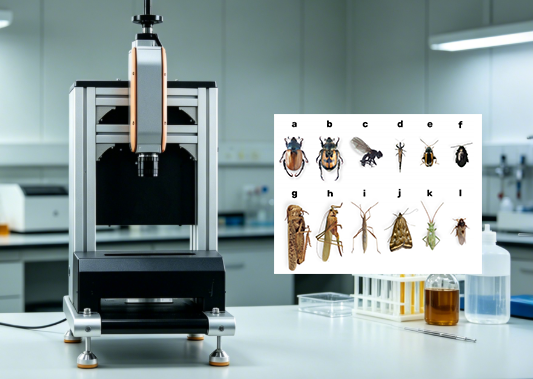
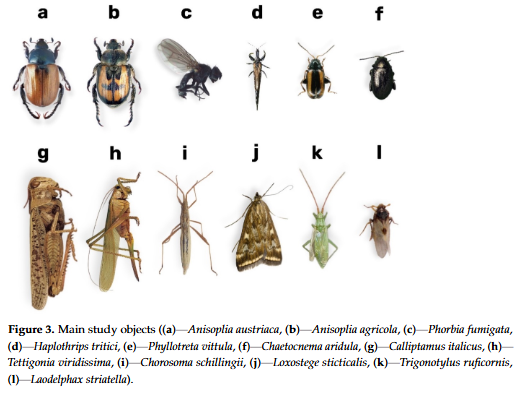
In December 2025, the international academic journal "Biology" published a research paper titled "Hyperspectral Imaging and Machine Learning for Automated Pest Identification in Cereal Crops." The research was completed by research teams from multiple universities in Kazakhstan. Using the FigSpec FS-13 hyperspectral camera produced by Hangzhou CHNSpec Technology Co., Ltd., they conducted spectral feature analysis and classification modeling for 12 major pests in wheat fields, demonstrating the application value of this equipment in the field of agricultural pest monitoring.
Advantages of Hyperspectral Imaging in Insect Identification
Hyperspectral imaging technology can obtain hundreds of continuous narrow-band spectral information within the range of visible to near-infrared wavelengths (usually 400–1000 nm), forming a complete spectral curve for each pixel. Unlike ordinary RGB cameras, hyperspectral images not only record the spatial morphology of objects but also reveal the spectral response characteristics of their material components and surface structures.
For insects, factors such as different types of surface pigments, chitin structures, wing transparency, and surface roughness will produce unique spectral reflection characteristics. These "spectral fingerprints" enable hyperspectral imaging to distinguish morphologically similar species and even identify hidden pests.
Main Research Results
1.Significant differences in spectral characteristics of different pests
The research results showed that different insect species exhibited significantly different reflection spectral curves in the visible to near-infrared bands. The main influencing factors include:
- Surface pigments: Light-colored or bright insects (such as yellow-green, white) have higher reflectivity, while dark-colored or black insects (such as flea beetles) have lower reflectivity.
- Wing structure: Transparent or semi-transparent wings (such as wheat seed flies, wheat thrips) show high reflection peaks in the near-infrared region.
- Surface texture: Smooth elytra have higher reflectivity than rough or hairy body surfaces.
- Chitin types: Different crystal forms of chitin (α, β, γ types) affect spectral absorption characteristics.
For example, Trigonotylus ruficornis (red-horned mirid bug) has a reflectivity as high as 90–110% due to its light yellow-green body color; Chaetocnema aridula (cereal stem flea beetle) has a reflectivity of only 10–20% due to its deep black body color.
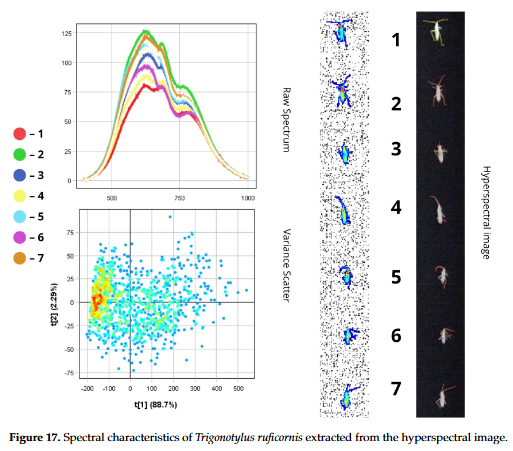
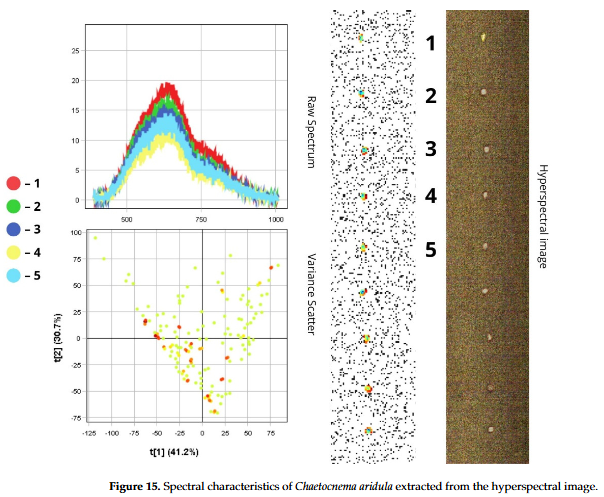
2.PCA analysis reveals the main components of spectral differences
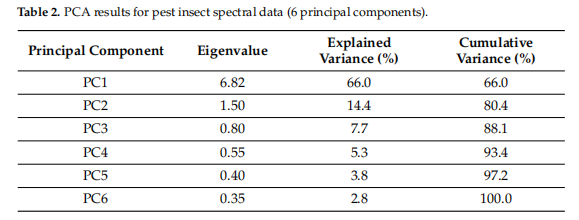
PCA dimension reduction analysis showed that the first two principal components could explain more than 80% of the spectral variance. The first principal component (PC1) mainly reflects the overall brightness difference, while the second principal component (PC2) is related to subtle body surface structures and pigment changes. Different species presented different degrees of cluster separation in the PCA score plot, providing a basis for subsequent classification.
3.Robust performance of the PLS-DA classification model
The research team constructed a PLS-DA classification model based on the spectral data collected by FigSpec FS-13 to identify 12 types of pests. Model evaluation indicators included the coefficient of determination (R²), predictive ability (Q²), and root mean square error of calibration (RMSEC). The results are as follows:
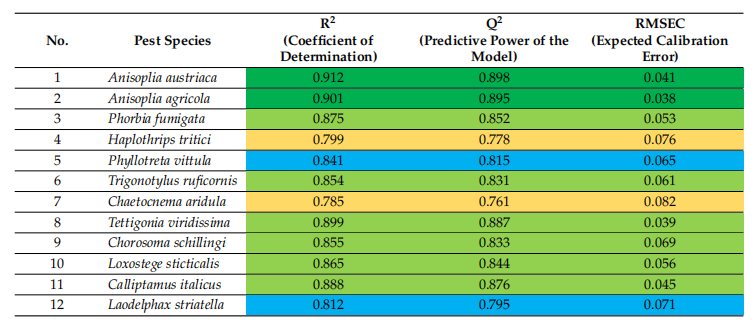
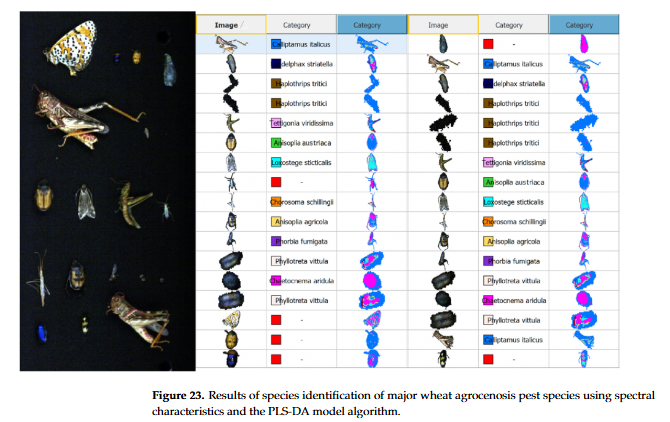
For species with vivid body colors and large sizes (such as scarab beetles, green bush crickets), the model identification accuracy can reach about 90%; for species with dark body colors and tiny sizes (such as flea beetles, thrips), the accuracy is slightly lower but still remains within an acceptable range. Overall, the PLS-DA model can effectively distinguish 12 types of pests, verifying the reliability of FigSpec FS-13 hyperspectral data in insect classification.
Conclusion
This research case demonstrates the application potential of the FigSpec FS-13 hyperspectral camera in insect pest spectral feature analysis and machine learning classification. As a domestically produced hyperspectral imaging device, the FS-13, with its stable performance and rich supporting analysis functions, provides a reliable tool for scientific research and industrial applications in fields such as agricultural disease and pest monitoring, food safety testing, and material sorting.
With the continuous growth of demand for precision agriculture and smart plant protection, hyperspectral imaging technology will play an increasingly important role in future farmland management.
(The original paper can be read by searching https://doi.org/10.3390/biology14121715)